We are here to laugh at the odds and live our lives so well that Death will tremble to take us.
The quest to understand the meaning of life has haunted humanity since the dawn of existence. Modern history alone has given us a plethora of attempted answers, including ones from Steve Jobs, David Foster Wallace, Anais Nin, Ray Bradbury, and Jackson Pollock’s dad. In 1988, the editors of LIFE magazine posed this grand question head-on to 300 “wise men and women,” from celebrated authors, actors, and artists to global spiritual leaders to everyday farmers, barbers, and welfare mothers. In 1991, they collected the results, along with a selection of striking black-and-white photographs from the magazine’s archives that answered the question visually and abstractly, in The Meaning of Life: Reflections in Words and Pictures on Why We Are Here . Here is a selection of the answers.
Pulitzer Prize winner Annie Dillard:
We are here to witness the creation and abet it. We are here to notice each thing so each thing gets noticed. Together we notice not only each mountain shadow and each stone on the beach but, especially, we notice the beautiful faces and complex natures of each other. We are here to bring to consciousness the beauty and power that are around us and to praise the people who are here with us. We witness our generation and our times. We watch the weather. Otherwise, creation would be playing to an empty house.
According to the second law of thermodynamics, things fall apart. Structures disintegrate. Buckminster Fuller hinted at a reason we are here: By creating things, by thinking up new combinations, we counteract this flow of entropy. We make new structures, new wholeness, so the universe comes out even. A shepherd on a hilltop who looks at a mess of stars and thinks, ‘There’s a hunter, a plow, a fish,’ is making mental connections that have as much real force in the universe as the very fires in those stars themselves.
Legendary science writer Stephen Jay Gould:
The human species has inhabited this planet for only 250,000 years or so-roughly.0015 percent of the history of life, the last inch of the cosmic mile. The world fared perfectly well without us for all but the last moment of earthly time–and this fact makes our appearance look more like an accidental afterthought than the culmination of a prefigured plan.
Moreover, the pathways that have led to our evolution are quirky, improbable, unrepeatable and utterly unpredictable. Human evolution is not random; it makes sense and can be explained after the fact. But wind back life’s tape to the dawn of time and let it play again–and you will never get humans a second time.
We are here because one odd group of fishes had a peculiar fin anatomy that could transform into legs for terrestrial creatures; because the earth never froze entirely during an ice age; because a small and tenuous species, arising in Africa a quarter of a million years ago, has managed, so far, to survive by hook and by crook. We may yearn for a ‘higher’ answer — but none exists. This explanation, though superficially troubling, if not terrifying, is ultimately liberating and exhilarating. We cannot read the meaning of life passively in the facts of nature. We must construct these answers ourselves — from our own wisdom and ethical sense. There is no other way.
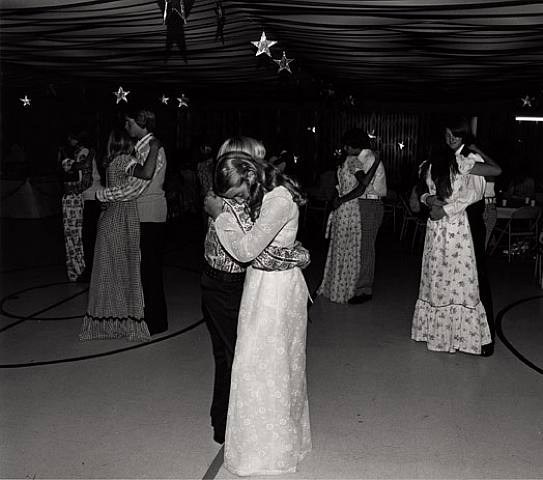 Bill Owens
Graduation dance
Bill Owens
Graduation dance
Frank Donofrio, a barber:
I have been asking myself why I’m here most of my life. If there’s a purpose I don’t care anymore. I’m seventy-four. I’m on my way out. Let the young people learn the hard way, like I did. No one ever told me anything.
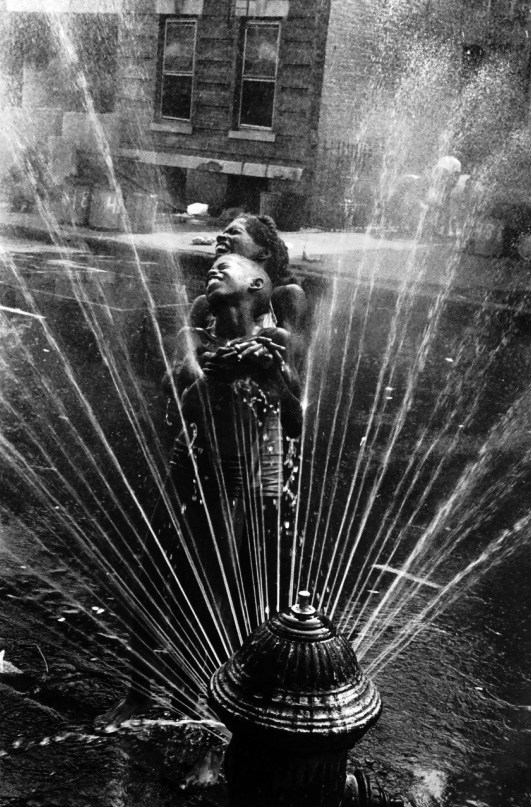 Leonard Freed
Harlem summer day
Leonard Freed
Harlem summer day
Science fiction writer Arthur C. Clarke:
A wise man once said that all human activity is a form of play. And the highest form of play is the search for Truth, Beauty and Love. What more is needed? Should there be a ‘meaning’ as well, that will be a bonus?
If we waste time looking for life’s meaning, we may have no time to live — or to play.
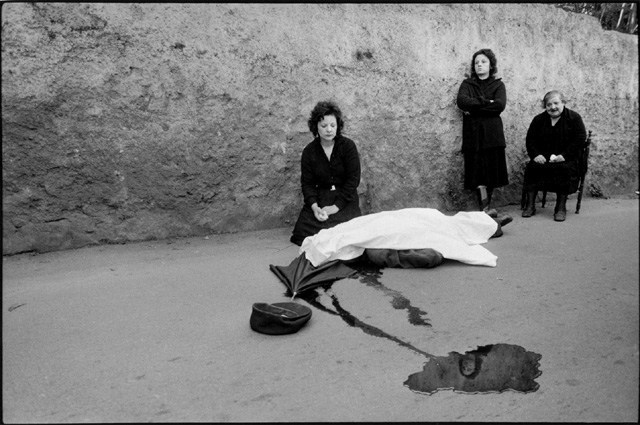 Franco Zecchin
Sicily
Franco Zecchin
Sicily
Literary icon John Updike:
Ancient religion and modern science agree: we are here to give praise. Or, to slightly tip the expression, to pay attention. Without us, the physicists who have espoused the anthropic principle tell us, the universe would be unwitnessed, and in a real sense not there at all. It exists, incredibly, for us. This formulation (knowing what we know of the universe’s ghastly extent) is more incredible, to our sense of things, than the Old Testament hypothesis of a God willing to suffer, coddle, instruct, and even (in the Book of Job) to debate with men, in order to realize the meager benefit of worship, of praise for His Creation. What we beyond doubt do have is our instinctive intellectual curiosity about the universe from the quasars down to the quarks, our wonder at existence itself, and an occasional surge of sheer blind gratitude for being here.
Poet Charles Bukowski:
For those who believe in God, most of the big questions are answered. But for those of us who can’t readily accept the God formula, the big answers don’t remain stone-written. We adjust to new conditions and discoveries. We are pliable. Love need not be a command or faith a dictum. I am my own God.
We are here to unlearn the teachings of the church, state and our educational system.
We are here to drink beer.
We are here to kill war.
We are here to laugh at the odds and live our lives so well that Death will tremble to take us.
We are here to read these words from all these wise men and women who will tell us that we are here for different reasons and the same reason.
Avant-garde composer and philosopher John Cage:
No why. Just here.
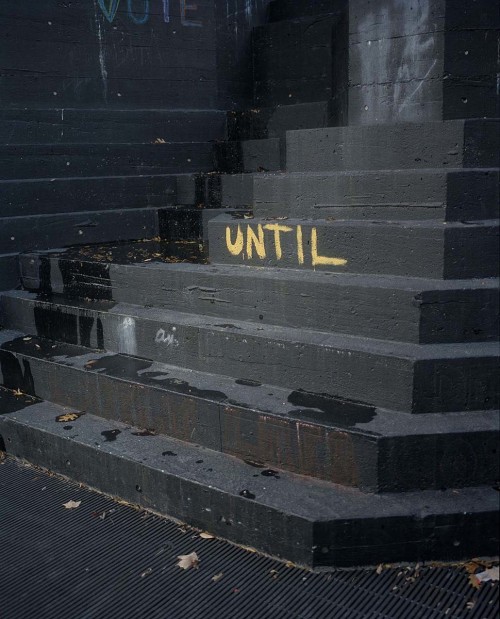
 memoryhouse