Category: Philosophy
Love of wisdom
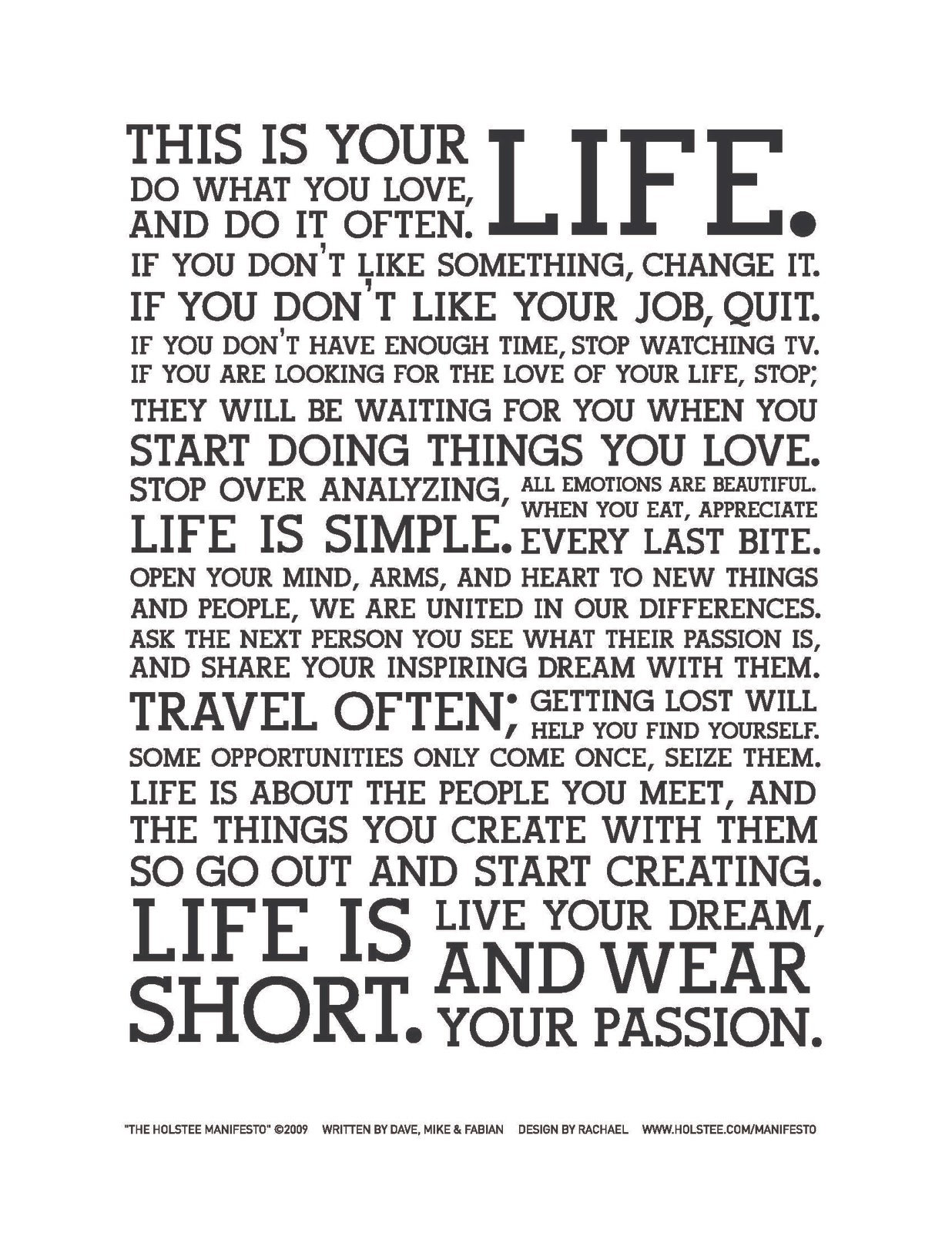
The Holstee Manifesto
The Tyranny of Choice
 One of my favourite books of last year was Freedom by Jonathan Franzen. I was in a bookshop yesterday and saw the paperback and it brought to mind the central theme of the book, which is beautifully encapsulated in a review by Philips Delves Broughton:
‘…This is the key theme of the book, and the reason for the title. We pampered creatures of the 21st century are ruined by our own freedom. Instead of bringing us happiness, it brings us only uncertainty. Having eschewed the certainties and disciplines of earlier generations, we find ourselves lost and adrift, propelled by the lingering emotions of childhood into futile searches for meaning.’
Questioning choice
Questioning freedom has become quite fashionable of late. But it’s the questioning of choice that interests me: the freedom and number of choices that we have, how we make them and the impact they have upon us. Can you have too much choice? Of course you can. More and more research is illustrating that, far from bringing us happiness and satisfaction, too much choice, too many options, can bring us deep unhappiness and dissatisfaction. It can depress us and even paralyse us. Faced with too many choices – we make none. Or in a panic to make what we think is the “right” one our mind becomes clouded and we choose poorly. When it comes to a spot of retail therapy poor choices no longer have the consequences they once did – you can pretty much return anything you want and make another choice or you can get a refund. The risk is negated. But there are many, many choices that we make in life for which there is no return policy. The paths we take, even though they may seem insignificant at the time, can have an indelible impact upon who we are and what we might become. Pretty obvious stuff really.
We tell ourselves stories
But what part does the culture in which we are brought up play in the choices we make? Or even how we come to approach and view them? Can examining how different cultures and people make their own and collective choices bring us greater wisdom and understanding? Well, yes – of course.
In her essay, The White Album, Joan Didion writes:
‘We tell ourselves stories in order to live. We interpret what we see, select the most workable of the multiple choices. We live entirely by the imposition of a narrative line upon disparate images, by the ideas with which we have learned to freeze the shifting phantasmagoria which is our actual experience’.
This passage forms a core part of a TED talk given by Pyscho-economist, Sheena Lyengar called: The Art of Choosing. It’s an outstanding and insightful talk about the choices we make – both the trivial and the deeply profound and how we feel about them. Toward the end of the talk she says:
“No matter where we’re from and what your narrative is, we all have a responsibility to open ourselves up to a wider array of what choice can do, and what it can represent. And this does not lead to a paralyzing moral relativism. Rather, it teaches us when and how to act. It brings us that much closer to realizing the full potential of choice, to inspiring the hope and achieving the freedom that choice promises but doesn’t always deliver…”
Unreal expectations
As expectations of ourselves, each other and the world around us get ever higher – often reaching levels that are simply unachievable and unattainable, which leads only to disappointment, disillusion and, in the case of many relationships, to dissolution – it’s worth remembering that the freedom of choice can become a tyranny. Sometimes less really is more…
The Power of Vulerability
“Connection. It’s why we’re here. It’s what gives purpose and meaning to our lives. This is what it’s all about. What we know is that connection, the ability to feel connected, is –neurobiologically that’s how we’re wired — why we’re here…”
Vulnerability isn’t comfortable. It’s just necessary. It’s the willingness to say “I love you” first…the willingness to do something where there are no guarantees…being willing to invest in a relationship that may or may not work out…this is fundamental. This is where courage and strength lies…
The School of Life
For many the new year signifies lots of things – resolutions, new beginnings, re-evaluations and a chance to believe that we will re-shape and re-script our lives along happier, perhaps more fulfilling paths. perhaps you’re one of the lucky few who is happy on the road you’re currently treading. But whether you are looking to make a detour or a pitstop or pack your brain bag and completely start again – there is one place I found a little while ago that might help. It’s time to go back to school. A school unlike any other; one that teaches lessons far more valuable than algebraic formulations or the difference between amo, amas and amat. This is the School of Life we’re talking about. No really. It’s actually called The School of Life. And before you start sneering in the way that we have been so conditioned to in these ever increasingly cynical times stop that lip curl and bear with me. Because this place is an absolute treasure trove.
Founded by Sophie Howarth, previously a curator at Tate, the school is part shop, part schoolroom with classes on philosophy, relationships, value systems and so on. The school also runs weekends away and, perhaps best of all, dinner evenings in great restaurants in London called, Conversation Dinners. Stop sneering at the back and don’t knock it til you’ve tried it.
The classes are about the practical application of philosophy on life’s core subjects – love, politics, work, family and play. Taking place over a weekend or six evenings (depending upon what fits in best with you) they’re structured around the burning questions that keep lots of people awake at night – how important is sex – why am I struggling – how can I live a meaningful life – why can’t I find/keep the love I so desperately crave?
The course on love is absolutely brilliant and was created with input from one of my all time favourite writers, John Armstrong (more on him in a not too distant post.) The courses are very interactive and rigorous and as far from self-help as you can possibly get. I can’t recommend them highly enough.
However, if you don’t want to commit to a course then at least be sure to make a visit to the school just to check out the bookshop – it’s very, very small but the selection is bang on the nose. They call it a, ‘pharmacy for the mind’ and that’s a great description. All the books have been handpicked by the team that work there and represent the best writing on all sorts of subjects; from being love-sick, worrying you’re a bad parent to just wanting some tips on how to get the best out of life. The opening hours are a little restrictive (closed at the weekends) but I really recommend a trip as the selection is constantly changing and evolving. I picked up a brilliant anthology of Barthes there as well as the most amazing book on relationships, which I’ll be covering in the not too distant future on this blog.
Finally, more on the conversation dinners. They’re an unrivalled opportunity to meet people in a relaxed setting and simply talk. Whether it be about philosophy, life, travel, music or the things which move and engage you the most. As a way of meeting new people who share similar passions they’re hard to be beat. In a world where we seek ever more increasingly bizarre and remote ways to connect with people the art of real conversation does seem to be dying out. And when there’s opportunities like these on offer then it’d only be a fool who would turn them down or not delve just a little deeper.
So there we are. The School of Life. I wish I’d known about it a long time ago – there are some valuable lessons to be learned there. Go.
Meaning of life
 Philosophy – the very word can be a barrier, seemingly impenetrable and lacking in relevance to anyone other than navel gazers or academics who relate more to books than they do to people. But leave any preconceptions at the door and it can be a fascinating subject, rich in ideas and potential answers to some of the most fundamental questions upon which we all ponder, however briefly or privately.
I grant you, the work of some philosophers is so impenetrable and dense that you find yourself almost suffocating in words and sentences that simply meander before finally ending very closely up their own backsides.
But there are others out there, writing now, who have opened up the subject in incredibly diverse and enriching ways – posing questions and answers to some of the most pressing concerns of what shapes our lives.
Many of these contemporary philosophers write about the things which interest me most – human relationships and how we communicate, behave, interact with and love or hate one another. What drives us, what should drive us and what we might one day become.
I have found that some modern philosophy has helped me greatly in gaining a greater understanding of both myself and the kind of man I want to be as well as giving me insight into the people I have loved and lost as well as those I continue to hold in my life.
One of the most easily accessible ways I have found of finding out the meaning of things from people far wiser than me was not just through books (more of which in another post) but through a brilliant series of podcasts featuring short interviews with some of today’s greatest thinkers. The series is called, Philosophy Bites and you can find out more and subscribe to the series by following the link at the end of this post.
I have embedded one of the first Philosophy Bites podcasts I listened to and whilst at first it might seem incredibly dry I do urge you to give it a chance.
This particular podcast deals with the most fundamental question of them all – the meaning of our lives. I like it because it talks about the interior cultivation of ourselves. And that belief in something does not necessarily come before the practicing of it – i.e. you should embark upon the practice of things before you begin to believe. I rather like that philosophy…
Listen to: John Cottingham on The Meaning of Life
Click here to listen to more Philosophy Bites podcasts
 memoryhouse