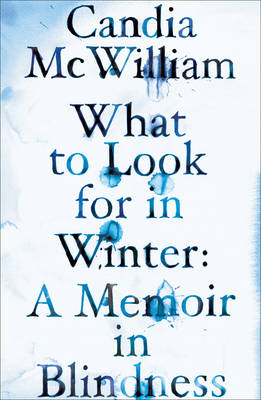
What to Look For in Winter: A Memoir in Blindness

This past weekend has definitely been all about books. So rock ‘n’ roll I know. Following on from my post about The Road I was going to blog about the poet whose work I dashed up to Foyles to buy but then I thought no, there’s actually another book I want to wax lyrical about first. Because it’s the one I’m currently engrossed in. And I think it might be one of the best I’ve read in the realm of story-telling for a long time. And it’s a true one.

The book is called, What to Look For in Winter: A Memoir in Blindness and is by Candia McWilliam. It’s an autobiography and usually I steer clear of autobiographies/biographies because I’ve always assumed that they must simply be a recall of one event after another with not much in the way of narrative to necessarily connect them. Plus I’ve never really been enough of a fan of anyone “real” as to  be fascinated enough to read about the minutiae of their life. But this may be a silly preconception because if there are biographical books out there anywhere near as good as this then I’ve been closing myself to an astonishingly rich vein of literature.

But to return to the book. Candia McWilliam is a Scottish author whose entire life had been subsumed by reading, as the book blurb says, her life “depended on reading and writing”. And so it was a particularly cruel twist of fate that, having only just joined the judging panel for the Booker Prize five years ago, she began to lose her sight. She suffered from  blepharospasm, a condition which means that the sufferer cannot open their eyes of their own volition. Her eyes were normal – she simply could not open them. It was her experience of this crippling and awful disorder that prompted her to create her memoir. Parts of it she wrote as her eyesight was failing her and some she dictated to a friend. Whether recorded by pen or dictation it is a remarkable memoir to read for even before her eyes closed she had had a raw and emotional life. This memoir is not just the story of how she coped with her darkening world but also her past struggles with alcoholism, her mother’s suicide and a past filled with sorrow, pain and love.

Her writing is wonderful. I know that some critics found it indigestible and apparently accused her of name-dropping throughout the book in such a manner as to be distracting and vain. Yes, there are a lot of names in the book, some well-known of course but it never feels like they are being dropped in your lap in an effort to impress. Rather that this was the circle she inhabited and so they make an appearance but they are often fleeting ones. And they don’t stick out or make you question why they are there. Well, at least I didn’t question why. This is very much her and her family’s story. And she tells it with such wit and passion and with such a brilliant way with words that I have found myself almost enthralled by the language alone. I love the words she uses – at the beginning of the book she speaks of how certain words burrow their way into her mind and that the newest to do so whilst she was dictating the book was: epilimnion. Epilimnion. What a beautiful word I thought. It means the upper, warmer layer of water in a lake. The part then that we swim in, that buoys us.

I cannot recommend this book highly enough – even though I’m only halfway through it myself. It is an incredibly raw story but also an enormously illuminating one in so many enriching ways. This is no ‘misery memoir’. It is someone’s search for a sense of self. And it is brilliant.

It begins:

“I am six foot tall and afraid of small people.

I am a Scot.

I am an alcoholic.

There is nothing wrong with my eyes.

I am blind.

I cannot lose my temper though I am being helped to…

I exude marriedness and I am alone.

This book is, among very many other things, an attempt to find that temper in order that I may lose it, and in losing it, perhaps, find my lost eyes…”
The Road – Cormac McCarthy

It’s been a “bookish” day today. I sped up to town when I found out that Foyles in London had some work in stock by a poet I’ve been wanting to read for some time. I want to blog about her later this weekend, once I’ve had a chance to actually read some of her work in depth. But browsing amongst the books today got me thinking about those that have really had an impact and whose words have stayed with me, echoing inside. There are, as you can imagine, quite a few. And yet I’ve been a little reticent to mention books on my blog. And I’m not sure why. So perhaps that’s something I should remedy.

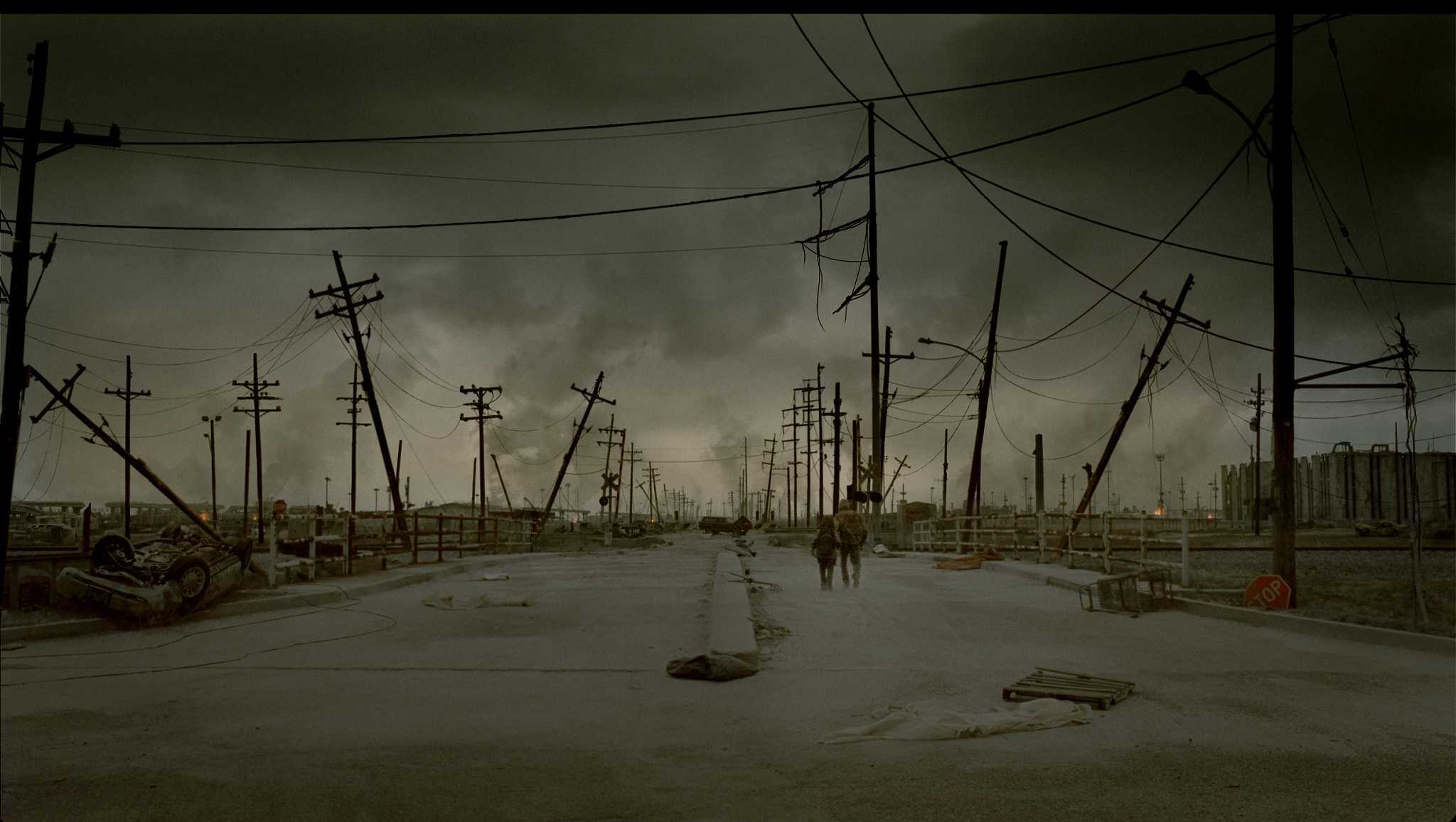
One of the books that really slammed into me (metaphorically speaking) was The Road by Cormac McCarthy. It wasn’t simply the harrowing story of a post-apocalyptic world that stirred the emotions but the central relationship at the heart of the story – that between a father and son. I’m a sucker (as they say) for anything remotely connected to fathers and sons. And The Road is a particularly moving account of a deep and abiding love; one which is surprisingly tender despite the savagery of the bleak and desolate landscape in which the father and son journey across.

If you’ve only heard of or seen the film I urge you to try the book. As is often the case, watching the film isn’t a patch on reading the book. McCarthy’s prose is nearly radically minimalist – even the dialogue is almost desperately sparse:

“Just remember that the things you put into your head are there forever, he said. You might want to think about that.
You forget some things, don’t you?
Yes. You forget what you want to remember and you remember what you want to forget.”

Yet because of their brevity every sentence seems to count. It’s this minimalism and the intensity of the images that the author paints in your mind that are almost impossible to translate to a screen and much of the quiet, contained power of those swift sentences is lost in the translation.

Where that power, intensity and tenderness have translated well though has been into the incredible sore for the film. Composed by Nick Cave and Warren Ellis the music is really quite beautiful and is almost a perfect evocation of the soul-stirring words contained within the book. Below are two of the standout tracks. And as for the book? It may sound utterly depressing and it’s true that it’s no easy read in terms of tone but it’s very far from maudlin or morbid and for something to tug at the heart-strings it’s very hard to beat…

Play track: The Road

Play track: The Beach

Sigur Rós – INNI: Festival

The band’s forthcoming live DVD and double album is now available to pre-order from the official website. There are about 4 different versions (of course) including the obligatory Limited Edition. As a taster of what’s to come a clip from the film (of the song, Festival) has been put out, which I’ve embedded below.
I’ve ordered my set. All that remains is for you to decide which one you’re going for because this looks like an essential release…

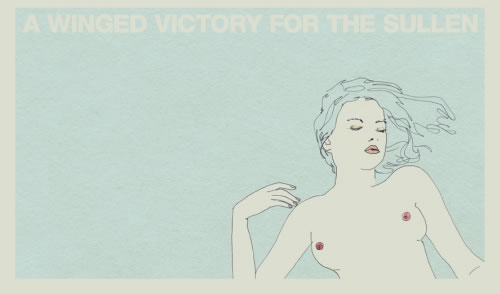
A Winged Victory For The Sullen


This could well be the late-night album you’ve always dreamed of. It’s a collaboration between the composer Dustin O’Halloran and Adam Wiltzie (from Sparklehorse). It’s entirely instrumental, consisting primarily of drone like strings, and it slips between neo-classical, ambient and post-rock spaces like honey. It’s like a balm for everything that hurts.

If ever music demanded that time-worn cliché of turning the lights down low and lighting the candles – then this is it. It’s beautiful, haunting and incredibly evocative. But you need to turn those lights down…

The Tyranny of Choice

One of my favourite books of last year was Freedom by Jonathan Franzen. I was in a bookshop yesterday and saw the paperback and it brought to mind the central theme of the book, which is beautifully encapsulated in a review by Philips Delves Broughton:
‘…This is the key theme of the book, and the reason for the title. We pampered creatures of the 21st century are ruined by our own freedom. Instead of bringing us happiness, it brings us only uncertainty. Having eschewed the certainties and disciplines of earlier generations, we find ourselves lost and adrift, propelled by the lingering emotions of childhood into futile searches for meaning.’

Questioning choice
Questioning freedom has become quite fashionable of late. But it’s the questioning of choice that interests me: the freedom and number of choices that we have, how we make them and the impact they have upon us. Can you have too much choice? Of course you can. More and more research is illustrating that, far from bringing us happiness and satisfaction, too much choice, too many options, can bring us deep unhappiness and dissatisfaction. It can depress us and even paralyse us. Faced with too many choices – we make none. Or in a panic to make what we think is the “right” one our mind becomes clouded and we choose poorly. When it comes to a spot of retail therapy poor choices no longer have the consequences they once did – you can pretty much return anything you want and make another choice or you can get a refund. The risk is negated. But there are many, many choices that we make in life for which there is no return policy. The paths we take, even though they may seem insignificant at the time, can have an indelible impact upon who we are and what we might become. Pretty obvious stuff really.

We tell ourselves stories
But what part does the culture in which we are brought up play in the choices we make? Or even how we come to approach and view them? Can examining how different cultures and people make their own and collective choices bring us greater wisdom and understanding? Well, yes – of course.

In her essay, The White Album, Joan Didion writes:

‘We tell ourselves stories in order to live. We interpret what we see, select the most workable of the multiple choices. We live entirely by the imposition of a narrative line upon disparate images, by the ideas with which we have learned to freeze the shifting phantasmagoria which is our actual experience’.

This passage forms a core part of a TED talk given by Pyscho-economist, Sheena Lyengar called: The Art of Choosing. It’s an outstanding and insightful  talk about the choices we make – both the trivial and the deeply profound and how we feel about them. Toward the end of the talk she says:

“No matter where we’re from and what your narrative is, we all have a responsibility to open ourselves up to a wider array of what choice can do, and what it can represent. And this does not lead to a paralyzing moral relativism. Rather, it teaches us when and how to act. It brings us that much closer to realizing the full potential of choice, to inspiring the hope and achieving the freedom that choice promises but doesn’t always deliver…”

Unreal expectations
As expectations of ourselves, each other and the world around us get ever higher – often reaching levels that are simply unachievable and unattainable, which leads only to disappointment, disillusion and, in the case of many relationships, to dissolution – it’s worth remembering that the freedom of choice can become a tyranny. Sometimes less really is more…

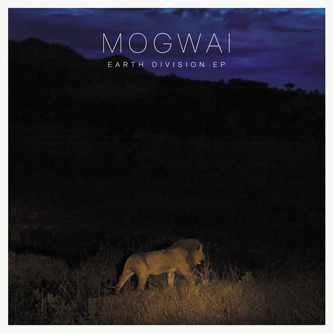
Mogwai – Earth Division EP

Scottish post-rockers Mogwai’s new EP is out on September 12th but it’s already available to listen to via soundcloud.
It’s really rather a lush EP favouring chamber instrumentation and a hint of neo-classicism with just a sprinkling of twinkling guitars and woozy harmonicas.

The first track is a particularly fetching piano ditty whilst the second introduces those harmonicas and, unusually for Mogwai, a vocal track. The third sees the band back on all too familiar territory with some scratchy guitar noise but stick with it because about 2 minutes in and boom – the guitars fall away and in come the strings with gorgeous effect. The set finishes on a classic post-rock note and a typically catching melody. It’s a great EP and the tracks are well worth a listen. So here they are…

A Sonnet

Sonnet XVII

I do not love you as if you were salt-rose, or topaz,
or the arrow of carnations the fire shoots off.
I love you as certain dark things are to be loved,
in secret, between the shadow and the soul.

I love you as the plant that never blooms
but carries in itself the light of hidden flowers;
thanks to your love a certain solid fragrance,
risen from the earth, lives darkly in my body.

I love you without knowing how, or when, or from where.
I love you straightforwardly, without complexities or pride;
so I love you because I know no other way

than this: where I does not exist, nor you,
so close that your hand on my chest is my hand,
so close that your eyes close as I fall asleep.

– Pablo Neruda

Click to listen